

The two main steps of solving problems using quantum computers are:
Formulate[1] your problem as an objective function
An objective function (cost function) is a mathematical expression of the problem to be optimized; for quantum computing, these are quadratic models and (for some hybrid solvers) nonlinear models that have lowest values (energy) for good solutions to the problems they represent.
Find good solutions by sampling
Samplers are processes that sample from low-energy states of objective functions. Find good solutions by submitting your model to one of a variety of D‑Wave’s quantum, classical, and hybrid quantum-classical samplers.
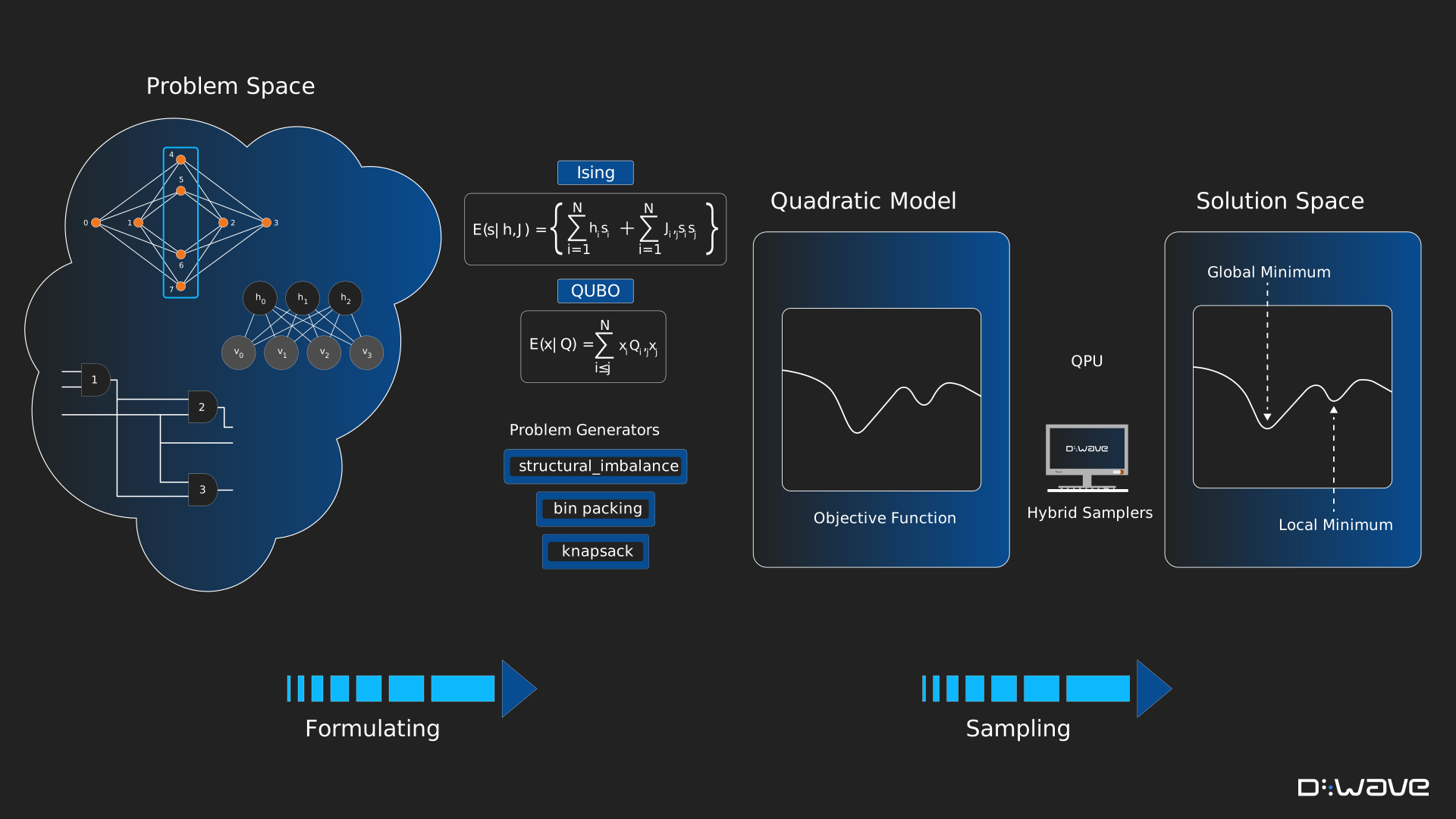
Solution steps: (1) a problem known in “problem space” (a circuit of Boolean gates, a graph, a network, etc) is formulated as a model, mathematically or using Ocean functionality, and (2) the model is sampled for solutions.#
To express a problem for a D‑Wave solver in a form that enables solution by minimization, you need an objective function, a mathematical expression of the energy of a system. When the solver is a QPU, the energy is a function of binary variables representing its qubits[2]; for quantum-classical hybrid solvers, the objective function might be more abstract[3].
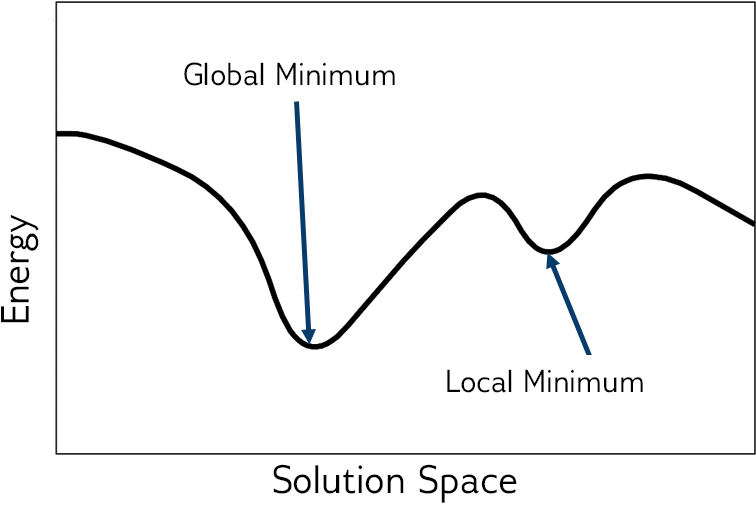
Energy of the objective function.#
For most problems, the lower the energy of the objective function, the better the solution. Sometimes any low-energy state is an acceptable solution to the original problem; for other problems, only optimal solutions are acceptable. The best solutions typically correspond to the global minimum energy in the solution space; see the figure above.
There are many ways of mapping between a problem—chains of amino acids forming 3D structures of folded proteins, traffic in the streets of Beijing, circuits of binary gates—and an objective function to be solved (by sampling) with a D‑Wave quantum computer, hybrid solver, or locally on your CPU. The Basic QPU Examples and Basic Hybrid Examples show some simple objective functions to help you begin.
For more detailed information on objective functions, how D‑Wave quantum computers minimize objective functions, see the What is Quantum Annealing? section; for techniques for reformulating problems as objective functions, see the Reformulating a Problem section.
For code examples that formulate models for various problems, see D-Wave’s examples repo and many example customer applications on the D-Wave website.
As an illustrative example, consider solving a simple equation, \(x+1=2\), not by the standard algebraic techniques but by formulating an objective that at its minimum value assigns a value to the variable, \(x\), that is also a good solution to the original equation.
Taking the square of the subtraction of one side from another, you can formulate the following objective function to minimize:
In this case minimization, \(\min_x{(1-x)^2}\), seeks the shortest distance between the sides of the original equation, which occurs at equality (with the square eliminating negative distance).
Samplers are processes that sample from low-energy states of objective functions. Having formulated an objective function that represents your problem (typically as a quadratic or nonlinear model), you sample it for solutions.
D‑Wave provides quantum, classical, and quantum-classical hybrid samplers that run either remotely (for example, in D‑Wave’s Leap service) or locally on your CPU.
QPU Solvers
D‑Wave currently supports Advantage and Advantage2 quantum computers.
Quantum-Classical Hybrid Solvers
Quantum-classical hybrid is the use of both classical and quantum resources to solve problems, exploiting the complementary strengths that each provides. For an overview of, and motivation for, hybrid computing, see: Medium Article on Hybrid Computing.
D‑Wave provides two types of hybrid solvers: Leap service’s hybrid solvers, which are cloud-based hybrid compute resources, and hybrid solvers developed in Ocean software’s dwave-hybrid tool.
Classical Solvers
You might use a classical solver while developing your code or on a small version of your problem to verify your code.
For information on classical solvers, see the Classical Solvers section.
Simple Objective Example#
As an illustrative example, consider solving by sampling the objective, \(\text{E}(x) = (1-x)^2\) found in the Simple Objective Example subsection above to represent equation, \(x+1=2\).
This example creates a simple sampler that generates 10 random values of the variable \(x\) and selects the one that produces the lowest value of the objective:
>>> import random
...
>>> x = [random.uniform(-10, 10) for i in range(10)]
>>> e = list(map(lambda x: (1-x)**2, x))
>>> best_found = x[e.index(min(e))]
One particular execution found this best solution:
>>> print('x_i = ' + ' , '.join(f'{x_i:.2f}' for x_i in x))
x_i = 7.87, 1.79, 9.61, 2.37, 0.68, -2.93, 3.96, 1.30, -3.85, -0.13
>>> print('e_i = ' + ', '.join(f'{e_i:.2f}' for e_i in e))
e_i = 47.23, 0.63, 74.19, 1.89, 0.10, 15.44, 8.77, 0.09, 23.50, 1.28
>>> print("Best solution found is {:.2f}".format(best_found))
Best solution found is 1.30
The figure below shows the value of the objective function for the random values of \(x\) chosen in the execution above. The minimum distance between the sides of the original equation, which occurs at equality, has the lowest value (energy) of \(\text{E}(x)\).
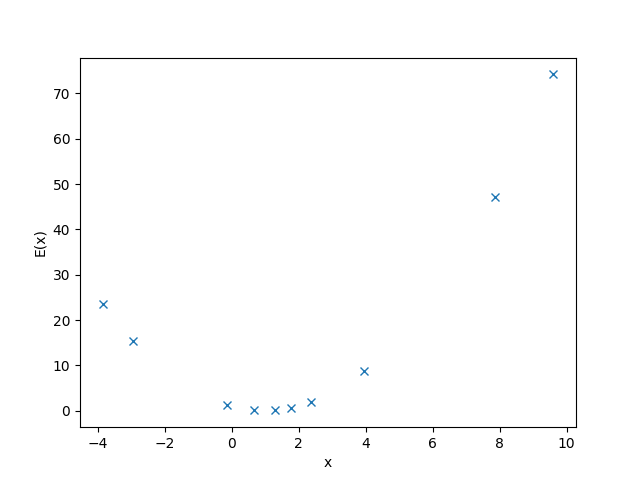
Values of the objective function, \(\text{E}(x) = (1-x)^2\), versus random values of \(x\) selected by a simple random sampler.#