

Leap Administration#
If you have project or organization administrator privileges, you can use Leap Admin to manage your projects or organizations.
Overview#
Leap Admin is an easy-to-use cloud-based administration tool that you use to perform the following major tasks:
Manage multiple projects in multiple organizations.
Invite people to a project. Projects are used to manage the project’s members and their solver access in the Leap service.
View the status of problems submitted to solvers.
Troubleshoot submission issues.
Generate solver usage reports.
For information about D‑Wave quantum computers, problems, and solvers, see the Get Started with Optimization or Get Started with Quantum Computing topics.
To get started quickly, go to the Quick Start topic.
Searching Globally#
Via the Global Search field as shown in Figure 262, you can search for projects and members across all projects in the current organization. The text matches any part of a project or member name (including an email address).
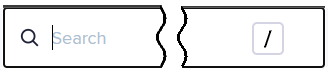
Fig. 262 Global Search#
Some Limitations
Searching is case-insensitive.
The Latin-1 character set is supported.
For project names, the Ä, ä, Ö, ö, ẞ, Ü, ü characters are also supported; however, diacritical marks are ignored.
The maximum number of characters is 254.
Tip
Use the Up and Down arrow keys to select an item in the results list and press Enter to go to the selection.
Member Roles and Privileges#
A member has one of the following roles and associated privileges. The roles are hierarchical in the following order, with Organization Admin at the highest level; as such, you can only perform actions for others who are at your role level and below.
Organization Admin |
Project member who has the following privileges in the organization and its projects:
|
Project Admin |
Project member who has the following privileges in the project:
|
User |
Project member who has the following privileges in the project:
Members that have the User role cannot access Leap Admin. |
Customizing How Information Is Displayed#
Leap Admin’s user interface is quite intuitive; you can filter and sort data
as well as customize the arrangement of columns using actions on the various
tabs and sections (e.g., Projects, Problem Status, and
Solver Access Time Schedule) by clicking the icons in the table headings or
above the table. Some icons are hidden until you place the pointer over data
that you want to act on; for example, placing the pointer over a problem ID
displays Copy  .
.
Some actions include the following:
Filtering rows by matching data in the rows
Sorting data in columns in ascending or descending order
Setting units for the data (e.g., time in units of seconds, minutes, hours, or all of them)
Reordering columns, including pinning a column to the left or right side of the table
Hiding and showing columns
Tip
Filtering and sorting is case-insensitive.
When filtering and sorting on project names, diacritical marks on the Ä, ä, Ö, ö, Ü, ü characters are ignored. Also, although project names that differ only by diacritical mark are grouped together, they may not always be sorted in the same order.
Terminology and Conventions#
Application
A program that submits problems to solvers.
Organization
Any organization such as a company or institution that has one or more associated projects.
Organization administrator
A project member who has the Organization Admin role.
Project
A logical or organizational grouping of project members that is used to manage members’ solver access.
Project administrator
A project member who has the Project Admin role.
Project member
A user who has joined a project in the Leap service, also known as a member.
Role
A role gives a member the privileges to perform specific actions in a project or organization. A role can be either Project Admin, User, or Organization Admin. The Project Admin role is intended for people who administer a project. The Organization Admin role is intended for people who administer an organization and its associated projects. Only members with the Project Admin or Organization Admin role can access Leap Admin. The User role is intended for people whose main activity is submitting problems.
For more information, see Member Roles and Privileges.
Seat
A seat represents access to a project’s solvers for a single member or application. A customer contract specifies the number of seats that are available for each seat type.
Seat type
A seat type specifies the capabilities and limitations of a seat; for example, a User seat is intended for members whose main activity is submitting problems.
For more information, see Seat Types.
Solver access limit
The maximum amount of solver-access time that a member or application can consume for a monthly renewal period. This maximum cannot be greater than the project’s total amount of solver-access time.
Solver-access time record
A solver-access time record is an amount of solver-access time for a specific period of days.
For more information, see Solver-Access Time Records.
For sequential steps in the user interface, variables are indicated in italics; for example, Leap Admin > project_name.
Quick Start#
The goal of this topic is to invite people to a seat-based project.
To log in to Leap Admin, you must have received an email to join a project as a project or organization administrator. If you did not receive an email invitation as expected, contact your organization administrator or D‑Wave Customer Support.
Note
If your invitation has expired or if you did not receive one, contact D‑Wave Customer Support.
To invite people to a project, perform the following tasks:
Logging in to Leap Admin#
Log in to the Leap service at https://cloud.dwavesys.com/leap/login/.
In the upper right corner of the dashboard, select Profile Avatar
 > Leap Admin as shown in
Figure 263.
> Leap Admin as shown in
Figure 263.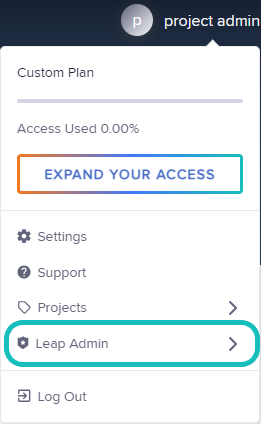
Fig. 263 Leap Admin: Login Menu#
Inviting People to a Project#
In the upper-right corner, click
 > Invite User and make the
appropriate selections.
> Invite User and make the
appropriate selections.You may find the following field descriptions helpful:
Role: A role gives a member the privileges to perform specific actions in a project. For more information, see Member Roles and Privileges.
Seat Type: For more information, see the following sections:
Tip
As a best practice, invite additional project and organization administrators as backups.
If the desired email address is not allowed as specified (individually or by pattern) in the Allowed Email Settings section on the Overview page, contact D‑Wave Customer Support.
Managing Organizations#
A customer contract defines an organization, which represents a company or institution in the Leap service. An organization contains one or more projects.
Note
Only organization administrators can view organizations.
To create an organization, contact D‑Wave Customer Support.
An organization’s page is displayed as shown in Figure 264, where tabs organize tasks into logical groups. If you have more than one organization, you can select one via a dropdown list.
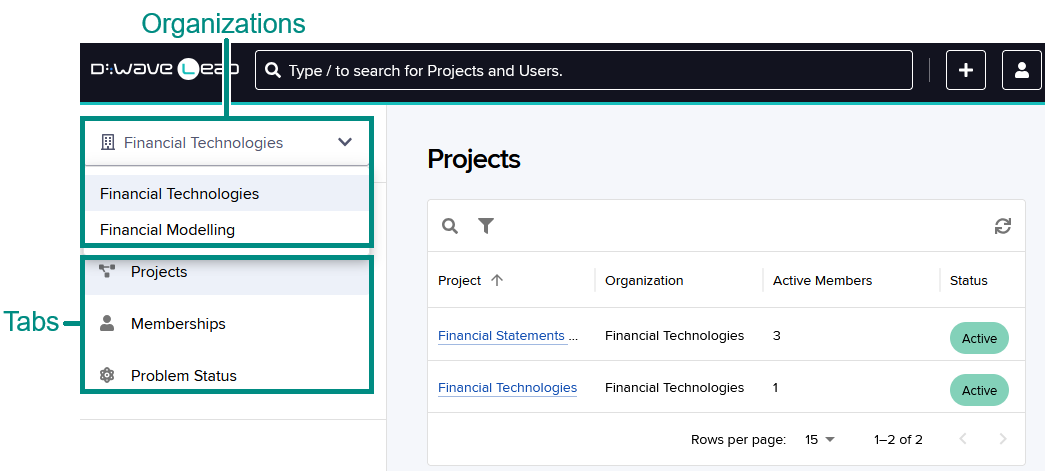
Fig. 264 Leap Admin: Organization Page#
Organization Administrators#
Organization administrators can invite people to the Leap service in any role as well as administer many aspects of the projects contained in their organization, including performing all tasks that a project administrator can.
Viewing Summary Information for Projects#
The organization’s Projects tab displays summary information for all projects in an organization.
You may find the following field descriptions helpful:
Monthly Usage: Amount of solver-access time that has been consumed in the project for the month.
Solver Access Time: Amount of solver-access time aggregated over all active records for the project.
Status: Status of the project. For a description of project statuses, see the Viewing Project Status section.
Managing Projects#
A customer contract defines each project, including the project type (seat- or time-based), the solvers that are available, and the allowed email addresses for project members.
In addition to viewing the email domains and subdomains (or individual email addresses) of the people who can be invited (also known as the “allowed email list”) and project-level information such as the available solvers and the project’s seats, you can change a few project settings, such as its customer reference ID, members’ limits on solver-access time, and seat types.
Note
To create a project or change a project’s allowed email list, contact D‑Wave Customer Support.
A project’s page is displayed as shown in Figure 265, where tabs organize tasks into logical groups.
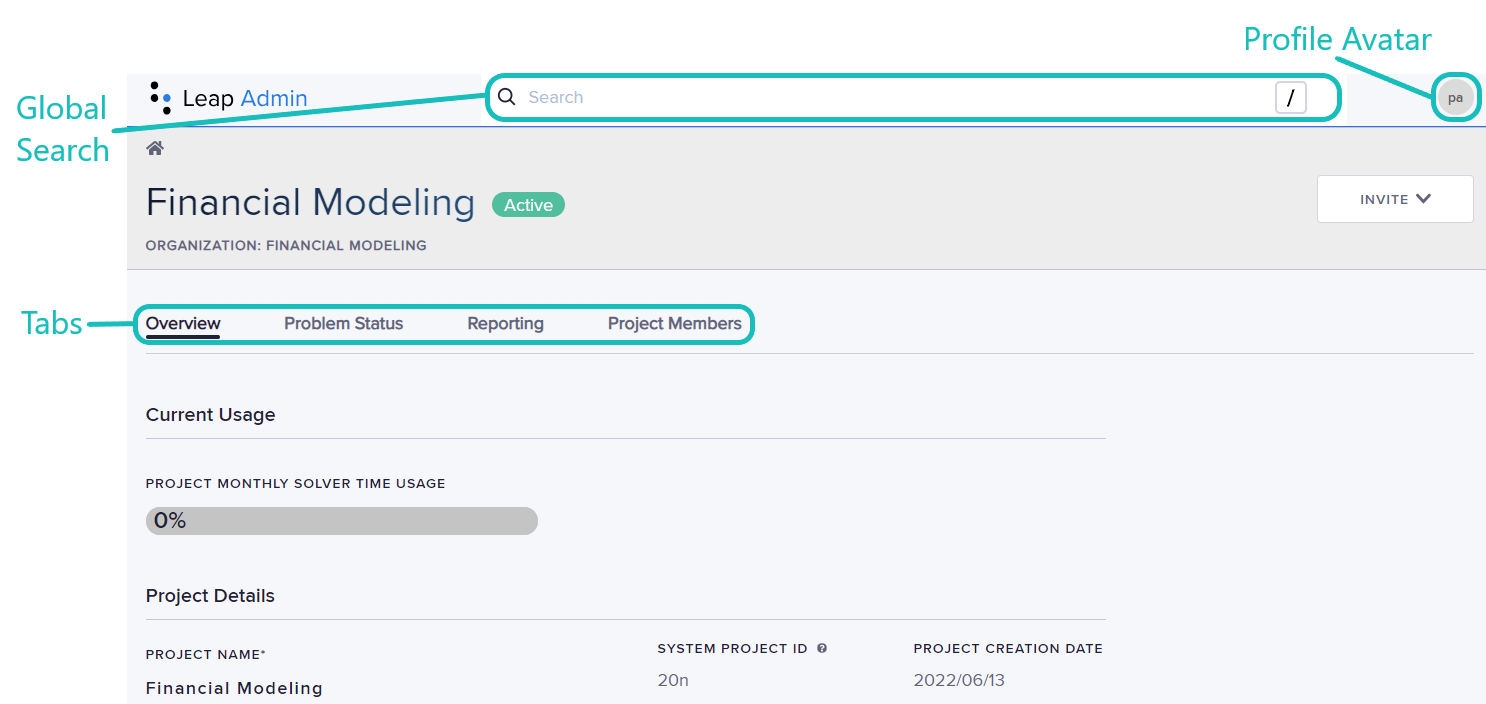
Fig. 265 Leap Admin: Project Page#
Seat- versus Time-based Projects#
Both seat- and time-based projects are supported as follows:
Seat-based projects enable you to easily assign a project member, such as a developer whose main activity is submitting problems, to a seat of a predefined type that best meets the member’s intended use.
Time-based projects do not have seats; instead you allocate an amount of solver-access time to each project member.
Viewing Basic Information#
Basic information about the project, such as its status is displayed on the project’s title banner.
You may find the following field descriptions helpful.
Project Code |
Unique identifier for a project. It is used for internal purposes, such as a prefix for the project’s API token. |
Project Type |
Classification of the project as determined by the customer contract; for example, Development. |
Customer Reference ID |
ID that you provide and which can be used for your specific internal processes. |
Monthly Usage |
Amount and percent of solver-access time used in the project for the current renewal period. |
Viewing Project Seats#
Each project member, whether a person or an application, occupies a single seat of a given type. The number of seats and seat types are determined by the customer contract. Each row in the Project Seats section represents a particular seat type, including such information as the number of seats currently occupied and the limit on solver-access time.
You may find the following field descriptions helpful.
Seat Type |
The name of the seat type. |
Seats Occupied |
A seat is considered to be occupied once an invitation has been sent. The number of members in a project at any one time cannot exceed the total number of seats available for all seat types. |
Solver Access Limit |
The maximum amount of solver-access time that a member or application can consume for a monthly renewal period. This maximum cannot be greater than the project’s total amount of solver-access time. |
To change a member’s seat type, see the Changing a Project Member’s Seat Type section.
Seat Types#
A seat type specifies the capabilities and limitations of a seat; for example, a User seat is intended for members whose main activity is submitting problems.
You can switch a member or application between seat types, but a member or application can only occupy one seat type at any one time.
Examples of seat types are as follows:
User |
Intended for members whose main activity is submitting problems; for example, a developer. This seat type provides an unlimited amount of solver-access time. |
Observer |
Intended for members whose main activity is administration or troubleshooting; they do not submit problems frequently. This seat type provides a limited amount of solver-access time. |
Service Account |
Intended for applications that submit problems; for example, a production application that submits problems on a schedule. This seat type provides an unlimited amount of solver-access time. |
Inactive |
Intended for members who should remain in the project but are temporarily inactive. They cannot submit problems to solvers. |
Viewing Solver-Access Time#
The Solver Access Time Schedule section displays the solver-access time records as determined by the customer contract.
Tip
A project administrator receives a notification when the project’s solver-access time reaches 80%.
You may find the following field descriptions helpful.
Monthly Solver Access Time |
A record’s amount of solver-access time available for each renewal period. Consumption of solver-access time is aggregated across all regions. Note: The maximum number of problems per member that can be in a solver queue is 1,000; if this maximum is exceeded, then problems are rejected. |
Allocation Start Date (UTC) |
The date (inclusive) that access is provided to solvers. This date is determined by the customer contract. |
Allocation End Date (UTC) |
The date (inclusive) that access to solvers ends. This date is determined by the customer contract. |
Anniversary Date (UTC) |
The anniversary date is used to calculate the renewal date for monthly solver-access time. |
Status |
Active: The current date is between the record’s start and end dates. Only active records contribute solver-access time. Disabled: The record was disabled by D‑Wave. Scheduled: The record has been scheduled for activation beyond the current date. When the current date reaches the record’s start date, then the record is activated. Expired: The current date has passed the record’s end date. |
Solver-Access Time Records#
A solver-access time record is an amount of solver-access time for a specific period of days. A gap or overlap of solver-access time can occur between records. For example, if a new contract states that solver-access time be increased by 1 hour for September, then instead of increasing the solver-access time for an existing record, a separate record is created for 1 hour of solver-access time from September 1 to 30.
Thus, record periods (in units of whole days) can be contiguous, overlap, or have gaps between them. Figure 266 illustrates the following:
A gap occurs between the set of records 1 and record 2 because the latest end date in the set of records 1 is not contiguous with the start date in record 2.
The records in the set of records 1 are contiguous.
In the set of records 1, the first and second records overlap.
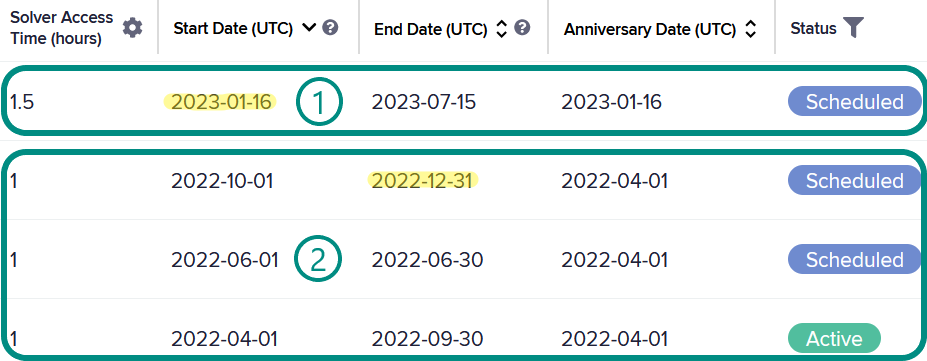
Fig. 266 Example of Solver-Access Time Records#
Renewal Date#
Solver-access time renews every month simultaneously for all active records. The renewal date is the day of the month that is specified in the anniversary date for all active records; however, if the anniversary date’s day of the month is greater than the last day of a renewal month, then the renewal date is the last day of the month. For example, if the anniversary date is January 31, then the next renewal date is February 28 (or February 29 in a leap year).
Note
If there is a gap between records and the first one expires, then the renewal date is set to the next record’s renewal date, which might differ from the first record’s renewal date.
Anniversary Date#
When a record is created, the anniversary date is automatically calculated as follows:
The anniversary date is the start date of the new record, if either of the following is true:
The new record is the only active or scheduled record in the project.
There is a gap between the new record and an active or scheduled record.
The anniversary date is the same as the existing active or scheduled records if the new record is contiguous with those existing records.
Viewing Available Solvers#
You view the solvers that are available in a project in its Overview > Solver Access Summary section.
Solvers are specific to a region (for example, Europe or North America). To display the solvers for a region, click the region name. The solvers that are available in a project are determined by the customer contract.
To view a solver’s properties and parameters, click its name in the Solver Name column. For more information on solver properties and parameters, see the Solver Properties & Parameters and Quantum Research sections.
Viewing Project Status#
A project’s status is the state of the project in the project life cycle as follows:
Tip
Project status is displayed in the project page’s title banner.
New |
The project has been created, but its start date has not been reached. You can specify the people to be invited, but the invitations themselves are not sent until the start date has been reached. |
Active |
The project has started as determined by its start date. Note: Invitations that have been scheduled are sent on the start date. |
Suspended |
The project cannot be used. Note: This is an exception state. If you believe your project should not have been suspended, contact D‑Wave Customer Support. |
Expired |
The end date for the project’s solver-access time has been reached. Project members can still log in to the project, but cannot run problems on the solvers. |
Changing the Solver-Access Time Limit for Time-based Projects#
Note
This feature applies to time-based projects only.
By default, any one project member can use up all of a project’s monthly solver-access time.[1] If you want to change this default or set a different limit for an individual member, do the following:
Edit the project page and deselect the Set Default Solver Access to Unlimited option.
In the Default Solver Access Limit field, specify the default limit on solver-access time for new members who accept the invitation for the project after this field has been set. Existing members are not impacted; they retain the current limit on their solver-access time.
You can override this default limit for an individual member; to do so, see the Modifying the Limit on a Member’s Solver-Access Time section.
Managing Project Members#
You manage project members by first inviting people to join a project and managing the invitation process, including sending them reminders to accept the invitation and revoking invitations. You can also change members’ roles, seat types, and solver-access time limits as well as remove members from projects.
Inviting People to Join a Project#
You invite people to join a project by sending them email invitations via Leap Admin. To join the project, the person must accept the invitation by clicking the link in the email. A person who is new to the Leap service must also create an account.
Invitations expire after 30 days; you can send reminders to people who have active invitations. If an invitation expires or is revoked, you can send a new invitation.
Access to the Leap service is supported only from certain regions. For more information, see the From What Countries Can I Access D-Wave’s Leap Quantum Cloud Service article.
When creating an account or joining a project, the person might be required to accept the D‑Wave terms and conditions. The customer contract determines whether or not this is required for people joining the project.
Note
To change whether accepting terms and conditions is required or not, contact D‑Wave Customer Support.
Procedure#
To invite people to join a project or organization, click >
Invite User and specify the fields.
You may find the following field descriptions helpful.
Organization |
(Read-only) Organization to which you are inviting people. |
Project |
Project to which you are inviting people. |
Seat Type |
An available seat type for the invitees. For more information, see the Seat Types section. |
Email addresses or member names (if they already exist in the Leap service) of the people you want to invite to the project. Tip:
Note: If the desired email address is not allowed as specified (individually or by pattern) in the Allowed Email Settings section on the Overview page, contact D‑Wave Customer Support. |
|
Role |
One of the project member roles to assign to a person: User, Project Admin, or Organization Admin. Only an organization administrator can assign the Organization Admin role. Once people occupy seats in a project, they have the privileges associated with their role as described in Member Roles and Privileges; for example, access to the project’s solvers. |
Set Solver Access to Unlimited (time-based projects only) |
Maximum amount of solver-access time available per month for the specified invitees. You set this maximum with one of the following options:
Sets the maximum amount of solver-access time to the same as that of the project’s Default Solver Access Limit field. |
Viewing the Status of a Member#
To view the status of a member, go to the Project Members tab and look at the Membership Status column.
Invitation Pending |
The invitation has been created but not sent because the project has not started. |
Invitation Sent |
The person has been invited to the project, but has not accepted. You can send a reminder. |
Invitation Revoked |
The invitation has been revoked. |
Invitation Expired |
The invitation to the person has expired. An invitation expires after 7 days. You can send a reminder. |
Active |
The person has accepted the invitation. |
Solver Access Expired |
The member’s solver-access time has expired for the project. |
Inactive |
The person is no longer a member of the project; however, the person might still be a member of another project. Nevertheless, the person’s statistics such as the problems they submitted and problem access time used are still displayed in the project. Note: This status is displayed for historical purposes. |
Sending Reminders#
You can send invitation reminders to one or more invitees.
To send an invitation reminder to an invitee, click
 >
Send Invitation Reminder.
>
Send Invitation Reminder.To send invitation reminders to multiple invitees simultaneously, select the invitees to which to send invitation reminders and use Manage Selected
 .
.
Resending Invitations#
You can resend invitations that have expired.
To resend an invitation, click
>
Resend invitation in the table on the Project Members tab.To resend the invitation to multiple invitees simultaneously, select the invitees for which to resend invitations and use Manage Selected
.
Revoking Invitations#
You can revoke invitations for one or more invitees.
To revoke the invitation for an invitee, click
>
Revoke invitation in the table on the Project Members tab.To revoke the invitations for multiple invitees simultaneously, select the invitees for which to revoke invitations and use Manage Selected
.
Viewing Member Information#
A list of members is displayed on the Project Members tab as follows:
User |
Name and email address of the member. Click the name to display more information about the member. Note
|
Seat Type |
A seat type gives a member a certain amount of solver-access time. For more information, see Seat Types. |
Role |
A role gives a member certain privileges. For more information, see Member Roles and Privileges. |
Project Usage for Month |
Displays the amount of solver-access time that a member has consumed for all solvers during the monthly renewal period. Solvers have different usage rates. For more information, see the Operation and Timing section. |
Solver Access Limit |
Displays the amount of solver-access time that is allocated to a member. |
Membership Status |
The status of the member in the project. For more information, see Viewing the Status of a Member. |
To display information about a specific member, click the project’s Memberships tab > member_name.
Changing a Project Member’s Seat Type#
On the project’s Project Members tab, click for a member
in the table and select Change seat type.
For example, if a project member who occupies a User seat is on vacation, you could temporarily free up their seat by changing their seat type to Inactive and then inviting another person to occupy the seat and submit problems until the vacationing member returns.
Note
Switching a member or application to a seat type with less solver-access time than already consumed in the current period disables problem submission for that member or application until the next period.
Modifying the Limit on a Member’s Solver-Access Time#
On the Project Members tab, click
for a member in the
table and select Modify Solver Access Limit.For multiple members simultaneously, select the members to modify and use Manage Selected
.
In the Modify Solver Access Time dialog box, select one of the following to set the desired limit on solver-access time:
Use Seat-Type Default — Sets the maximum amount of solver-access time to the seat type’s solver-access limit as specified in the Seat-Type Default Limit field.
Custom Amount — Sets the maximum amount of solver-access time to this custom value. This value must be equal to or less than the seat type’s solver-access limit as specified in the Seat-Type Default Limit field.
For time-based projects, sets the maximum amount of solver-access time to the lower of either this custom value or the sum of the project’s active solver-access time records.
Use Project Default (time-based projects only) — Sets the maximum amount of solver-access time to the lower of either the value in the Project Member Default Solver Access Limit field or the sum of the project’s active solver-access time records.
Unlimited Access to Project Solver Time (time-based projects only) — Sets the maximum amount of solver-access time to the full monthly solver-access time allocated to the project as determined by the sum of the project’s active solver-access time records.
Changing a Member’s Role#
On the Project Members tab, click for a member in the table
and select one of the following:
Remove Project Admin Role
Changes the member’s role to User.
Note
You cannot remove your own Project Admin role. Instead, ask another organization or project administrator to do so.
Remove Organization Admin Role
Changes the member’s role to User or Project Admin, whichever was the member’s previous role. Only an organization administrator can perform this action.
Note
You cannot remove your own Organization Admin role. Instead, ask another organization administrator to do so.
Assign project admin
Changes the member’s role to Project Admin.
Assign organization admin
Changes the member’s role to Organization Admin. Only an organization administrator can perform this action.
Removing Members From a Project#
You can remove one or more members simultaneously.
Note
You can only remove members whose membership status is Active.
On the Project Members tab, click
for a member and
select Remove from project.To remove multiple members simultaneously, select the members to remove and use Manage Selected
.
When members are removed, their statuses change to Inactive for the project and they can no longer use the solvers in the project. However, their usage statistics are preserved for historical purposes.
If you remove a member with the Organization Admin role from that member’s last project, then the Organization Admin role is also removed from the member.
If you want a person to rejoin a project or return as an organization administrator, send an invitation as described in Inviting People to Join a Project.
If you are the only organization administrator in an organization and you remove yourself from your last project, your Organization Admin role is removed and you will not be able to access the organization in Leap Admin. To reinstate access, contact D‑Wave Customer Support.
Managing Problem Submissions#
You manage problem submissions by viewing the status and details of problem submissions and cancelling problem submissions.
Viewing the Status of Problem Submissions#
To view the status of problems submitted to a project’s solvers, go to the Problem Status tab.
Tip
To display the most up-to-date status, click the Refresh Table
 .
.To copy a problem ID to the clipboard, place the pointer over the problem ID and click the subsequently displayed Copy
icon.If multiple regions are available, you can display the problems submitted only to a specific region’s solvers by using Regions
 .
.
You may find the following field descriptions helpful.
Problem |
The problem’s ID or label. The ID is system-generated. |
Status |
The status of the submitted problem. For more information, see Problem Submission Statuses. |
Problem Submission Statuses#
In the Problem Status column, the status of each problem submission can be one of the following:
Pending |
The problem was submitted, but the solver has not started working on a solution. |
In-Progress |
The problem was submitted and the solver is working on a solution. |
Completed |
The solver has successfully completed its work on the problem. |
Cancelling |
A request to cancel work on a problem is being processed. |
Cancelled |
Work on the problem has been cancelled. Cancelled problems do not use any solver-access time. |
Failed |
Work on the problem did not successfully complete. Failed problems do not use any solver-access time. |
Viewing Problem Submission Details#
To view a problem’s details, click a problem ID or problem label on the Problem Status tab. The following information is displayed:
Problem Parameters |
Displays the problem’s parameters, ID, solver, problem type, status, and embedded problem data. For more information, see the Solver Properties & Parameters and Quantum Research sections. |
Solution |
Displays the resulting sample set, if available for the solver. You can export the sample set along with its visualization. |
Timing |
Displays timing parameters for the problem. For more information, see the Operation and Timing section. |
Cancelling Problem Submissions#
To cancel pending or in-progress problems, select the problems and click the
Cancel Problems  .
.
Cancelled problems do not use any solver-access time.
Tip
Before cancelling problem submissions, display the most up-to-date status by clicking Refresh Table
.If you run scripts to continually submit problems, refresh the table after cancelling problem submissions to confirm that the cancellation attempts succeeded.
Generating Solver Usage Reports#
Reports on solver usage contain statistics that characterize how your projects and individuals use solver time in a project over a period of time. These statistics are organized into the following categories:
Information about the members who submitted problems
Number of submitted problems
Solver times with the following details:
Solver category: QPU, hybrid, or custom
Solver names
Totals and subtotals of solver-access times
The unit-of-time scale (for example, daily, monthly, and so forth) as specified in the Aggregate Time Scale field. For example, if Daily is selected, then solver usage is expressed as separate daily totals within the date range.
The statistics are exported as either an XLSX and CSV file. See the spreadsheet column headings for the exact statistics. On the Reporting tab, you specify filters for the statistics.
To configure and generate solver usage reports, go to the Reporting tab and specify the desired filter fields.
Tip
To get all values for a field, leave it blank. For example, to generate statistics for all members, leave the Users field blank.
To reset the filter fields to their default values, click Reset Template.